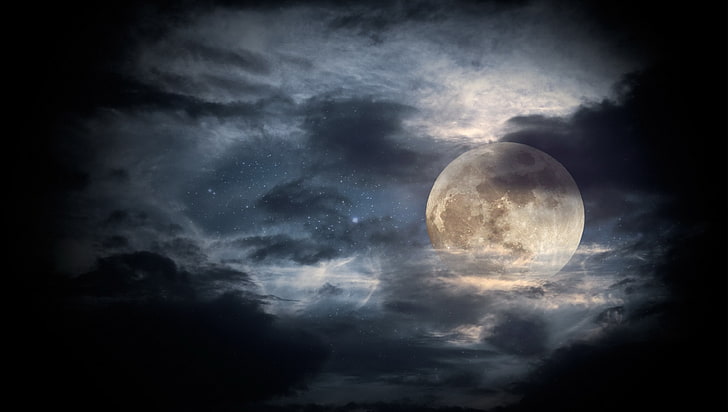
चंद्र (Moon)


चंद्र (Moon)


    पृथ्वीवरुन रात्रीच्या आकाशात उघड्या डोळ्यांनी पाहता येणारी खगोलीय वस्तु म्हणजेच चंद्र होय. चंद्र हा आपल्याला रात्रीच्या अंधारात दिसतो खरा पण चंद्राला स्वताचा प्रकाश नाही. सुर्याकडुन मिळणारा प्रकाश चंद्र पृथ्वीकडे परावर्तित करतो, त्यामुळे चंद्र आपल्याला प्रकाशमान दिसतो. चंद्र हा पृथ्वीचा नैसर्गिक उपग्रह आहे. चंद्र हा प्लूटो ग्रहापेक्षा देखिल मोठा आहे. चंद्रावर वातावरण देखिल आढळते. तेथील तापमानात प्रचंड बदल झालेले आढळतात. चंद्राच्या सूर्याकडील बाजुचे तापमान हे दिवसा 134°c तर रात्रीच्या वेळी -153°c इतके थंड असते. चंद्राला पृथ्वीभोवती फिरण्यासाठी 27.3 दिवस लागतात.


      चंद्राचे पृथ्वीपासुन सरासरी अंतर हे 3,84,400 किमी इतके आहे. चंद्राचे पृथ्वीपासून सर्वात जवळचे अंतर 3,63,300 किमी तर सर्वात दूरचे अंतर 4,05,500 किमी इतके आहे. चंद्राची गुरुत्वाकर्षन शक्ती पृथ्वीला आपल्याकडे खेचते त्यामुळेच पृथ्वीवरील समुद्र पातळीत वाढ होते. म्हणजेच भरती ओहोटी येते. चंद्र त्याच्या गुरूत्वाकर्षण शक्तीने पृथ्वीला आपल्या कडे खेचतो त्याचा हा प्रभाव आहे. तसेच यामुळे पृथ्वीवरील दिवसात दर 100 वर्षांनी 2.3 मिली सेकंदानी वाढ होते.

      चंद्राच्या संबंधीत दोन महत्वाच्या घटना म्हणजे अमावस्या आणि पौर्णिमा.

अमावस्या

    अमावस्येला सूर्य आणि पृथ्वी यांच्यामध्ये चंद्र येतो परंतु हे तिघे एका रेषेत नसतात. सूर्याचा प्रकाश चंद्रावर पडतो परंतु तिथून परावर्तित झालेला प्रकाश हा पृथ्वीवरील अंधाऱ्या भागात पोहचत नाही. परिणामी रात्रीच्या वेळी आकाशात पूर्ण अंधार असतो.


        पौर्णिमा


      पौर्णिमेला सूर्य आणि चंद्र यांच्यामध्ये पृथ्वी येते. यावेळेस देखील सूर्य, पृथ्वी, चंद्र एका रेषेत नसतात. सूर्याचा प्रकाश चंद्रावर पडतो, आणि चंद्रावरील परावर्तित झालेला प्रकाश पृथ्वीवरील अंधाऱ्या भागात येतो.


Comments

Post a Comment

Popular posts from this blog

10th Science -1 test (lesson 1-10)(English/Marathi)

  1.Gravitation - Test (25 Marks) *Instructions:* *    Attempt all questions. *    Marks for each question are indicated. *English * * Section A: Fill in the Blanks (1 mark each - 5 Marks)* 1.   The phenomenon of gravitation was discovered by __. 2.   The force acting on any object moving along a circle, directed towards the centre of the circle, is called the __. 3.   The value of the gravitational constant (G) was first experimentally measured by __. 4.   The acceleration due to Earth’s gravitational force is denoted by the letter __. 5.   In scientific language, when we say Rajeev's weight is 75 kg, we are actually talking about Rajeev's __.   * Section B: Define the following (2 marks each - 6 Marks)* 1.   Centripetal force 2.   Free Fall 3.   Earth's gravitational acceleration (g)   * Section C: Give Scientific Reasons (3 marks each - 6 Marks)* 1.   An apple falls ...

10th Science -2 test (lesson 1-10)(English/Marathi)

1: Heredity and Evolution (Marks: 25) Q. 1. Complete the statements by choosing correct options from bracket. (1 mark each) (Gene, Mutation, Translocation, Transcription, Gradual development, Appendix) a. The causality behind the sudden changes was understood due to the __________ principle of Hugo de Vries. b. Transfer of information from a molecule of DNA to mRNA is called the __________ process. c. Evolution means __________. d. The vestigial organ __________ present in the human body is proof of evolution. e. During protein synthesis, the ribosome keeps on moving from one end of mRNA to other end by the distance of one __________ codon. Q. 2. Define or Explain the following concepts. (2 marks each) a. Define Heredity.      b. Explain the concept of Central Dogma. Q. 3. Write short notes on any two of the following. (3 marks each) a. Lamarckism.       b. Connecting Links.       c. Vestigial Org...

10th Science -1 Notes (lesson 6-10)(English/Marathi)

  Lesson 6: Refraction of Light ( प्रकाशाचे अपवर्तन) English Notes: • Refraction of Light: The phenomenon where a light ray changes its direction when it passes from one transparent medium to another (e.g., pencil appearing broken in water, coin seen after adding water). • Laws of Refraction:     1. The incident ray, the refracted ray, and the normal to the interface at the point of incidence, all lie in the same plane .     2. For a given pair of media, the ratio of sin(angle of incidence, i) to sin(angle of refraction, r) is constant . This is known as Snell's Law . (sin i / sin r = constant) • Refractive Index:     ◦ The change in direction of light upon entering a different medium is related to the refractive index (n) of that medium.     ◦ Its value differs for different media and also for different colors of light within the same medium.     ◦ Absolute Ref...